An Interview with Sean Gallagher

Questions by Shallom Johnson, Art Editor

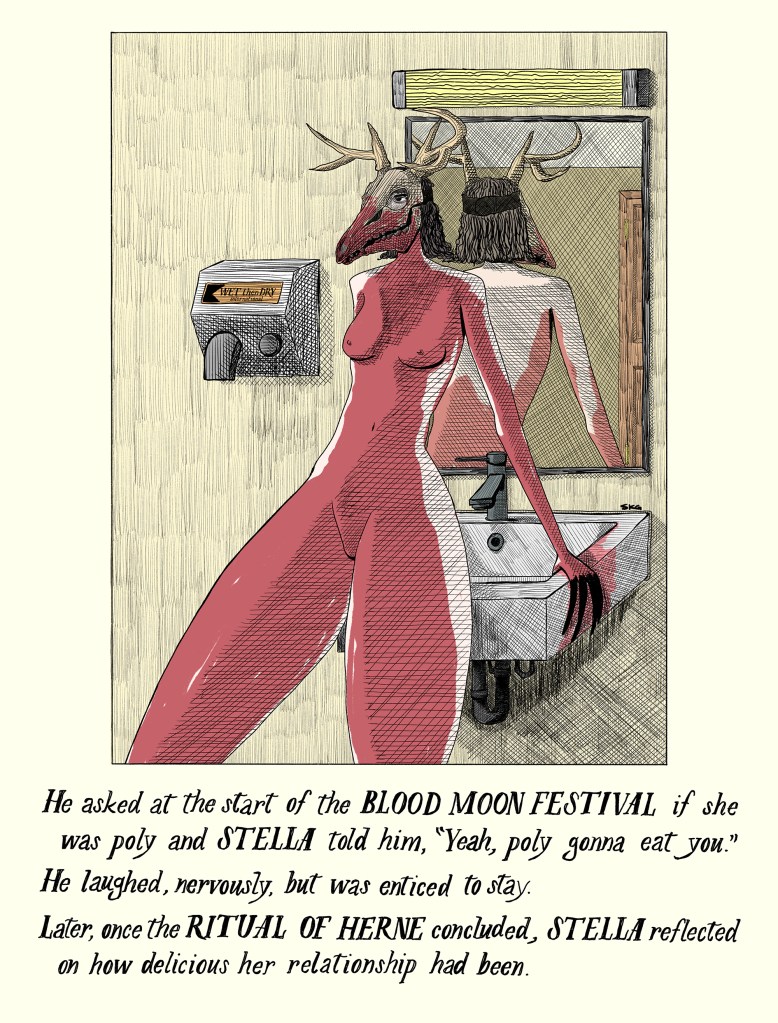
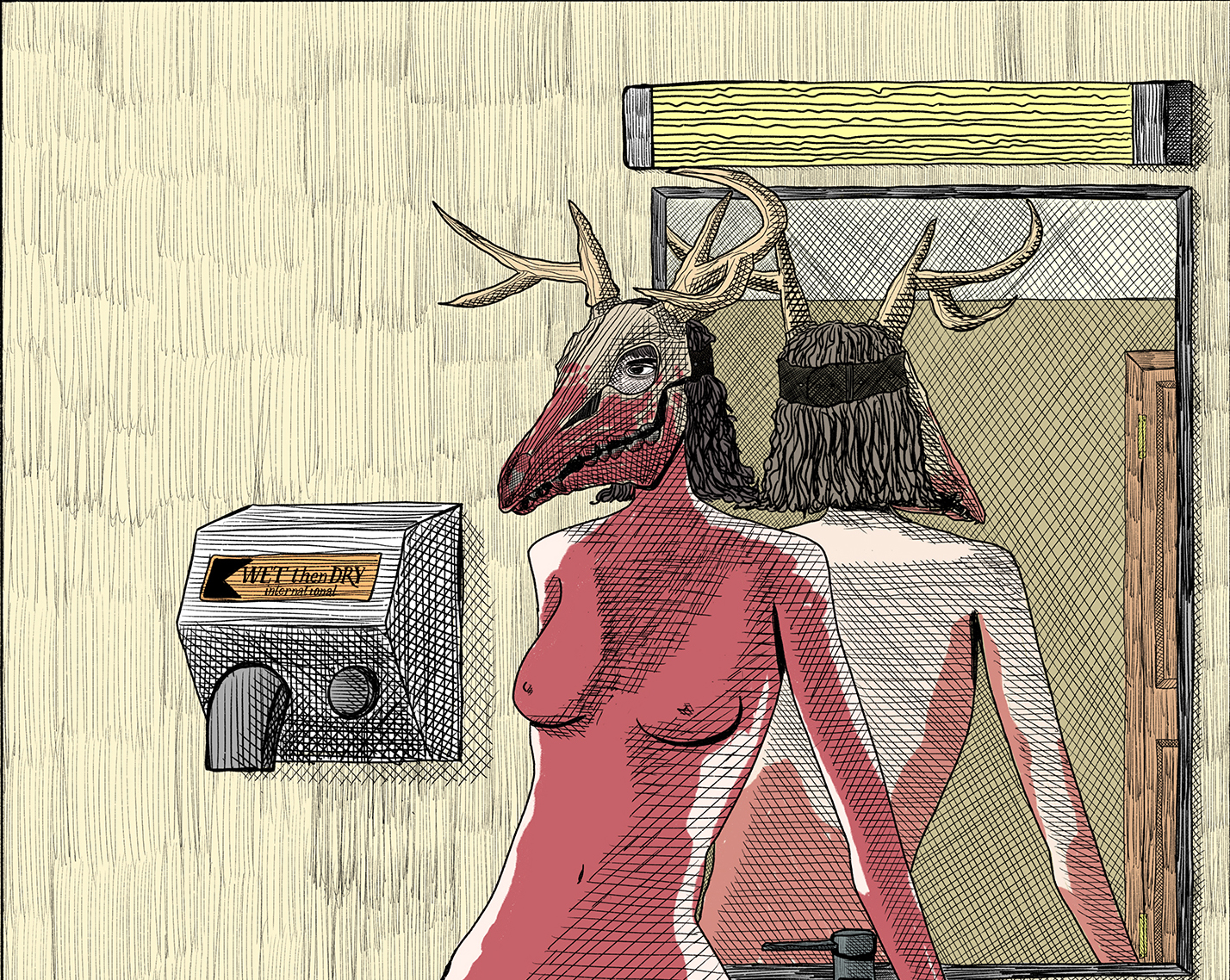
This illustration, Tasty Meal, seems to sit at the intersection of pagan mythology and pop culture. What was your inspiration for this piece, and how did it come together?

In all honesty, what inspired Tasty Meal was my love of horror movies, specifically horror movies that involve cults, especially cults whose rituals draw heavily from a gruesome, old-world paganism. Whatโ€™s great about horror is that it takes the humdrum of everyday life and turns it dreadful, that no matter what you do, no matter how much insulation you wrap your life in, you cannot escape the violence waiting on the periphery as if your end is just one wrong turn away. (And if the twist is that the supernatural elements thatโ€™ve only been hinted at turn out to be real and the elder gods appear to wreck gory retribution, thatโ€™s perfection.)

So, when I set out to make Tasty Meal, I knew I wanted the piece to not only draw from the hyperreality seen in these types of flicks, but also have a touch of humor โ€“ since the best part of any horror is the moment of levity that occurs right before the terrible tragedy befalls the characters (and the bloodier the pagan ritualโ€™s aftermath the better). 

Who are your biggest artistic influences?

This is going to be a madcap list, but artists Edward Gorey and Mike Mignola, photographers Diane Arbus and Saul Leiter, and filmmaker Dario Argento.

How would you describe your overall aesthetic?

Drawing influence from a gamut of creatives and mixing them together taught me to appreciate the ghoulish side of the everyday, discover beauty in the mundane, and reveal the dignity of outsiders. Essentially, I strive to make the in-between moments of life picturesque whether the piece exists in the light or dark.

I’ve always been in awe of artists who are able to tackle the enormity of a graphic novel project. Tell me about Maya Milner Makes a Meal, what was the original inspiration, what has the process been like to get to pitch stage, where is it heading next?

The funny thing about my traipse into making a graphic novel, or at least the beginnings of a graphic novel, was I originally envisioned myself writing and drawing childrenโ€™s books โ€“ a difficult profession to break into, but I persevered. One of the illustrated manuscripts I was most proud of was called Bathtime with Rio. After several edits, I sent it off and most of the responses I received were rejections, if I got a response at all.

There was one agent, however, who thought my writing and art showed promise, though she believed that Bathtime with Rio was too dark for kids. She suggested I put together a pitch for a graphic novel for a teenage audience. Inspired by folklore and monsters and my love of cooking, I combined these into a story about generational trauma and seeking new friends in a scary world where magic is ignored but not gone. Maya, the daughter of a chef, and her forest friend, a yeti-like creature who loves to paint, bond over the simple act of being invited over to sit at a table together and share a good meal.

I fleshed this all out in a detailed synopsis (along with putting together recipes to be included with the story), created character mock-ups and drew the first few pages, and emailed my pitch back to the agent. And that was it. I never heard back and my attempts at reaching out were disregarded, so I moved on and Maya Milner Makes a Meal currently sits in a drawer collecting dust. I occasionally think about returning to it, but I tend to quickly move on from projects without regret or desire to revisit them: When theyโ€™re put to bed, they stay asleep.

You’re currently working on your first animated reel, titled There Are Two Colors in My Head. Can you give our readers a sneak peek into the creation of this project?

Iโ€™ve always loved cartoons and used to make simple stop-motion films when I was younger. Nothing great, though I still have them on VHS. Silly projects to pass the time and amuse my friends. I still return to animation occasionally when I sense my artwork needs that extra โ€˜oomphโ€™ to enliven it. I animated There Are Two Colors in My Head because I felt the piece, while enjoyable, was a tad stale. I wanted to test my abilities to see what I could produce while also turning what I thought was a good piece into a delightful one. The result has helped me to grow and map out a handful of other animation projects I plan to start in the coming months. 

You have previously mentioned that your work has undergone a transition from darker or more political themes to a focus on entertaining snapshots of everyday life. What led you to this evolution, and why?

I pivoted away from the darker, more political themes due to one word: exhaustion. Itโ€™s difficult to maintain the rage and annoyance and stay in the narrow lane of being a reactionary. If youโ€™re not careful, itโ€™ll consume you, so I moved away from it. I didnโ€™t check out. I merely adjusted my priorities and focus and once I allowed the process to start, I evolved, and my art really took off. Thereโ€™s a wider world of creativity beyond snark and anger and takedowns that is nuanced and happy and vast and doesnโ€™t take a toll on your mental health. 

So as a painter who hasn’t had a consistent visual art practice in over 8 years, this question is dear to my heart. Talk to me about taking a break from art and finding it again in a different form. You have said that in your former practice, you thought you were a painter. You’ve since developed a vibrant body of work as an illustrator. What lessons have you taken away from this experience?

Iโ€™ve worn a number of hats throughout my professional life and stumbled through a lot of careers. Iโ€™ve tried my hand at being a journalist and a writer and a photographer and teacher and graphic designer. Intermingled with all these different jobs are brief spurts of retail jobs Iโ€™d rather not talk about. Throughout all of this, however, Iโ€™ve used creativity as an escape. At one point I saw myself as a painter because that was my escape at the time. Before that, I was a print cartoonist. Recently, as I mentioned, I attempted to break into childrenโ€™s illustration. These escapes were worthwhile but never satisfying because they all reached an endpoint neither anticipated nor wanted. But I had to move on.

I never let myself get dissuaded, though, and kept pushing myself and exploring where I could go, confronting my fears and hesitations and always picking myself up after failures and brushing off the dirt and nursing my wounds and continuing to push forward while also understanding that the end goal is entirely unformed. Iโ€™m constantly reinventing and reinvigorating myself and my skills. Not to sound too hokey, but creativity has no map, itโ€™s about taking the route less taken. The best plan is to have no plan and be excited to see where it all lands (while keeping all the terrified screams in your head).

What are you looking forward to for the year ahead?

Well, Iโ€™ve got a handful of publications ahead and looking forward to seeing my art out in the greater world. Iโ€™ve also got potential gallery opportunities to plan for as well as other chances to get my artwork in front of audiences. Iโ€™m also seeking representation, so Iโ€™m โ€œpatientlyโ€ awaiting word from the various agencies Iโ€™ve sought out. This is the plan for now, but like I said before, itโ€™s really just a suggestion for the future.

Anything we haven’t asked about that you’d like to mention?

I think youโ€™ve covered a lot. Hopefully, I didnโ€™t ramble on too much. 


Sean Gallagher lives in Charleston, South Carolina. His artwork has appeared or is forthcoming in Allegory Ridge, The Closed Eye Open, Passengers Journal, Vineyard Literary, Liminal Spaces, Fauxmoir Literary Magazine, Quarter Press, and High Shelf Press. He has also been highlighted as one of the lowcountryโ€™s top emerging artists by Charleston Magazine.ย 

skgcreative.com

Instagram

An Interview with Shah Bukht Fatima

Questions by Shallom Johnson, Art Editor

Tell me a bit about your life as an artist. What does your daily creative practice look like?

Sometimes I deal with a lot of new ideas, trying new techniques and other days I struggle with finding the right motivation and inspiration. Since I am not a full time artist and have to learn a lot given I am self taught, it requires a lot of pre-planning for me. Generally, my creative practice is saving a lot of art tutorials, inspirations and ideas and just finding the right time to correctly work on them.

You have recently begun creating artwork on commission. What was your journey like to get to this point in your career?

I have been making art since I was very young and always wanted to study art. Little me didn’t know she could keep working on her art and didn’t necessarily need to get a degree for it so that realization that I could still do it professionally was quite late. Also, due to my education fields being completely different from visual arts, the only visuals involved in my studies were initially biology diagrams and then visualization of economic statistics! After I completed my Mphil the pandemic came, and I finally had the time and clarity to just indulge in my silly little paintings again. That’s when I started painting, as initially I just used to sketch pencil portraits. 

One day I randomly painted a scene from a Ghibli movie, posted it on social media and somebody bought it! That really gave me the confidence to keep continuing it. Surprisingly, as a beginner artist, I got many requests for commissioned artwork and the commissions didn’t stop thankfully. It really happened just like my parents would tell me, to focus on my studies because I can do my artwork after I am done with my education and comically enough that’s what happened (insert evil laugh).

We need to talk about the lemons

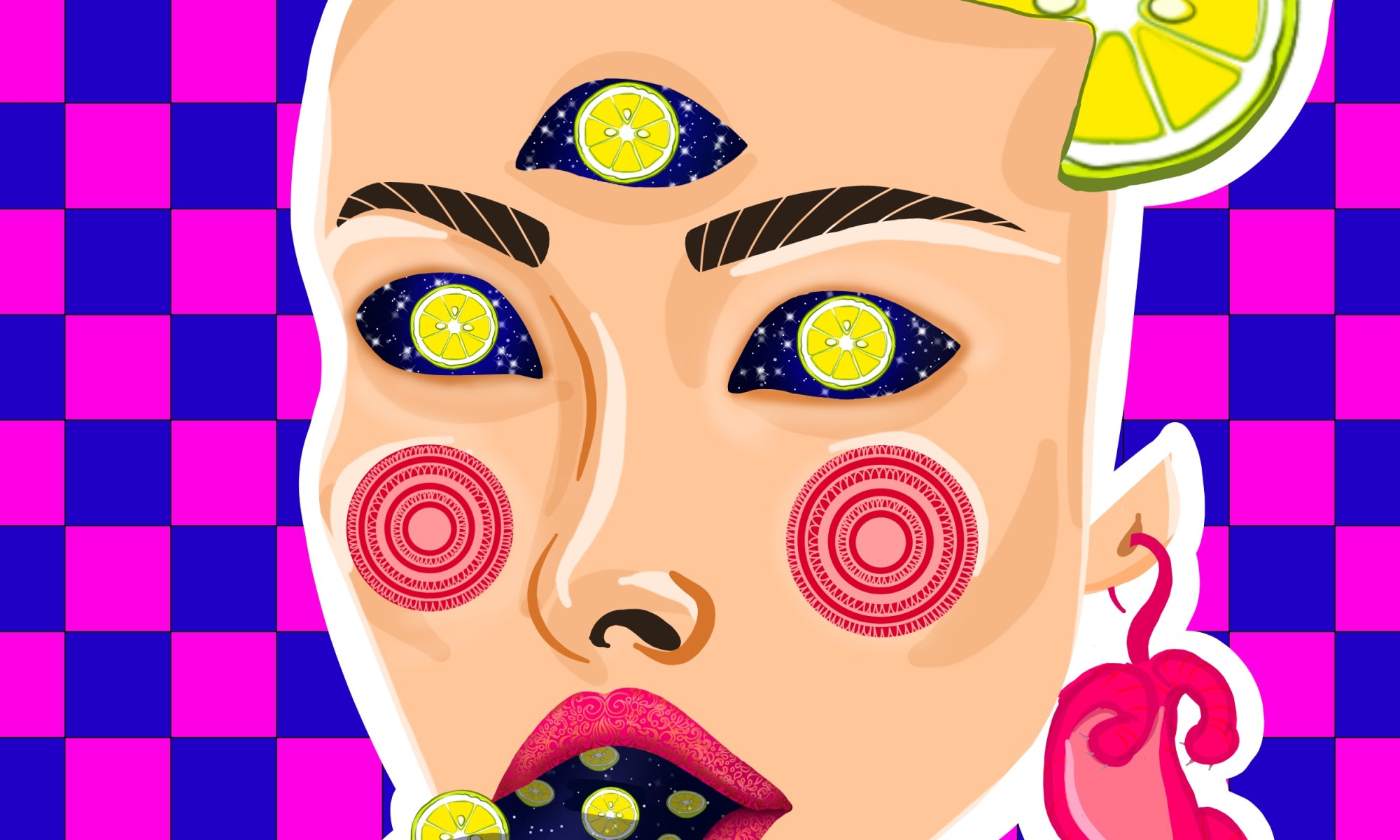
Tell me about this piece, We need to talk about the lemons. What was your inspiration? What was the process from inspiration to finished product?

We need to talk about the lemons was a little experiment I did with my art style, as I was trying to create something of my own and slightly different from what I usually created (landscapes and fanart basically). My initial inspiration was the abstract graphic art style I saw while going through some magazines. I wanted to illustrate something expressing my life in the context of existing as a woman, employing those styles. 

This artwork, as I titled it altering the proverb ‘when life gives you lemons you make lemonade’, is focused on the lemons more than the lemonade. I have always found this expression not as positive as it has been implied to be, because life doesn’t really give you lemons and lemons aren’t something bad either so it just never made sense to me (I identify as a hater of technically incorrect proverbs and expressions). What I depicted was just the existence of a face; my face or simply a woman’s existence within the bounds and rigors of patriarchy. The brain doesn’t exist in this frame of reference as we keep creating lemonade from the supposed lemons thrown at us by life, but it does not matter at all since the whole idea is fundamentally wrong. 

We need to talk about the lemons is about questioning the lemons. To me, what we call lemons are simply the unfairness of patriarchy and its stereotypes, internalized by everyone in most cases. I only added the lobe of the ear to the face to depict how we are limited from listening to and thinking about alternative and marginalized ideas and opinions, and the lemons in the eyes to show the same internalization and acceptance of whatever has been fed to us since the beginning regarding life, hardships, right and wrong and what-should-be in a gendered background. 

I hung a cat as an earring to add the stereotype of the crazy cat lady (being one myself) and how all this design of othering women, creating harmful stereotypes of them and for them, only to justify the inequalities they face in an intersectional setting. I also added a dance floor-ish background to give the performative nature of our lives because I just went haywire with adding concepts. As Shakespeare said, all the world’s a dance floor, right.

Which artists are inspiring you lately?

I keep finding such amazing artists every other day! Recently, I have been following the artwork of Zahra Azhar, a Pakistani still life and fantasy oil painter. Her technique and compositions are so hauntingly unique and have a strange nostalgic quality to them and her work really inspires me to create better oil work.

My favorite landscape artists these days are the French artist Sergiu Ciochina and Pakistani artist Aimen Khan. My favorite thing about their work is their use of colors and light/shadow by Sergiu and the detailing and perspective of Aimen’s art. 

Another Pakistani fantasy artist Benazir Khan Lodhi has also been inspiring me to do more Gouache work as her extremely detailed fantasy and fairy-core illustrations are wonderful. Maria Dimova is also one of my favorites these days for her amazing portrait illustrations.

Your work explores many mediums, from digital to oils, gouache to pen and more. What is your favorite medium to work with, and why?

I feel every medium has a different outcome, pros and cons, and every medium brings something new to work with so I cannot really pick a favorite. But I have come to find that using all the traditional mediums in digital form is quite interesting and more efficient for me. Especially given my issues with focus, I have found digital painting to be really better in the context of easy access as you don’t need to set up your gadgets and create a certain atmosphere which you might typically need for the non-digital artworks.

Does your writing have an effect on your visual art, and vice versa? How do these two creative streams intersect?

My writing and visual art generally do not intersect much. I have been writing more of unhinged gore and horror while my artwork has been more inclined towards vibrant portraits and landscapes. Although I really wish I could mix them more since it has been one of my art and writing goals to express my dreams/ nightmares in both forms. Hopefully, in the near future I might create a space of similarity between the two! 

Where can our readers view more of your work?

You can view my artwork on my Instagram and my writings on Commaful and Medium profiles.


Shah Bukht Fatima is a Pakistani writer and visual artist. She indulges in both traditional and digital paintings and illustrations, in various art styles and mediums. Her artwork intends to utilize the female gaze in addition to simply creating things which make her happy. She has also published three poems in the anthology series titled “Tales of the Heart” published by The Black Ink publications.  

Twitter

Instagram

Commaful

Medium

An Interview with Roger Camp

Questions by Shallom Johnson, Art Editor

Bronze Tomb, Monmarte Cemetery, Paris, 18หš

Tell me a bit about the trip to Paris when these three photos were taken. Do these images have any particular memories associated with them?

When I travel abroad I make a point of visiting cemeteries as they are often a microcosm of the history and culture of the place I am visiting. The bronze statue gives us a life sized model (more accurate than a photograph) of the person buried there. It contains all kinds of information about 19th century life: clothing, grooming, etc. In France they often list the person’s professions and honors as well. The fallen leaves provide the alert viewer with the time (Fall) the image was made.

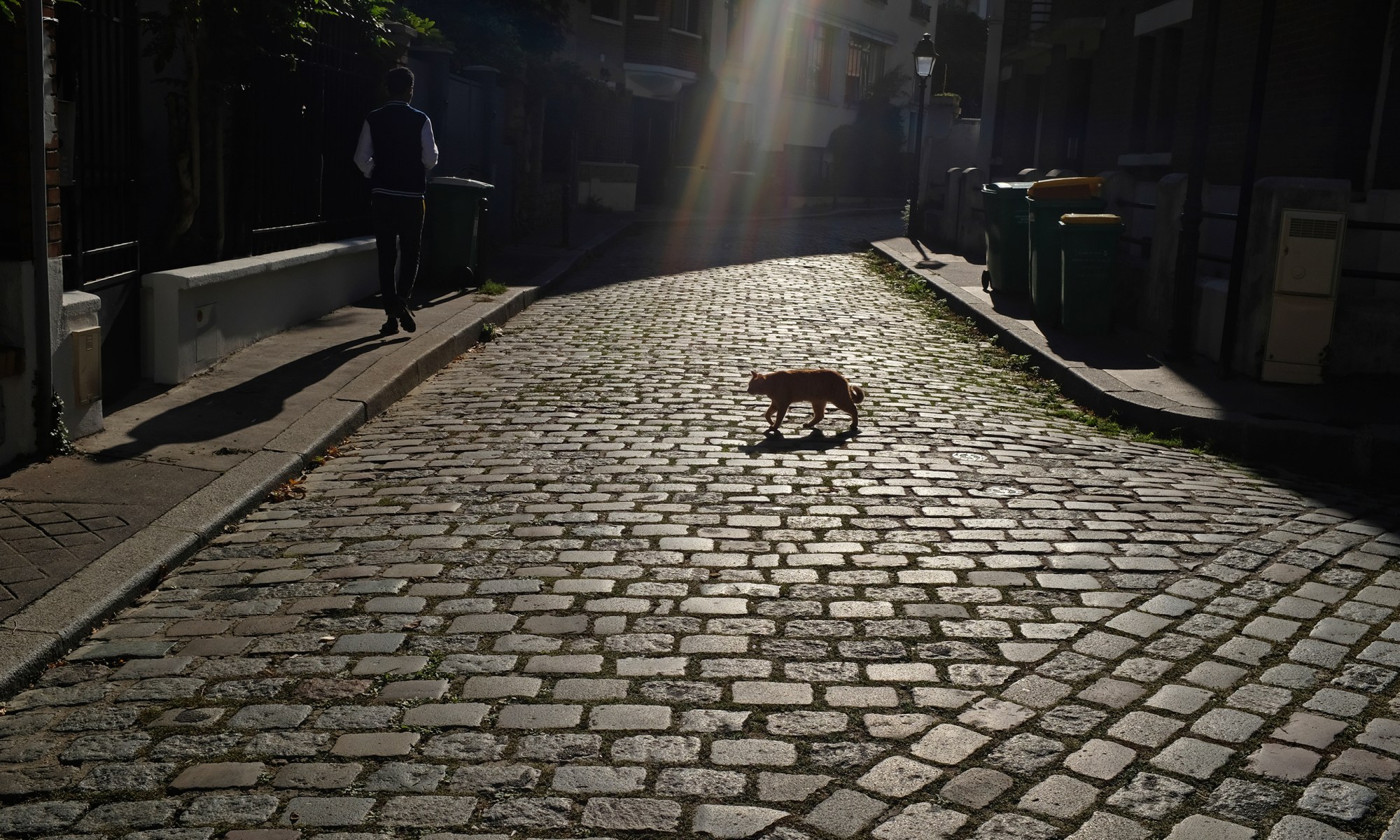
I like to explore Paris’s streets in the early morning light. I happened to look behind me just as this cat was crossing the street. It was one of those fortuitous moments, unplanned and unexpected and a wonderful memory as a result.

Your life as a photographer began during a long distance bicycle journey at age 15. With what intentions did you approach the act of documenting that initial journey? How have your intentions around travel photography evolved with time and maturity?

I have a scrapbook of that bicycle trip. Most of the photographs are snapshots of sights along the way or my camp at night.  However, there are several images that go beyond those. One taken while actually riding the bike across the Mojave Desert. A rather unique point of view. Another of a row of boat hulls that is concerned with pattern and form. I simply don’t take photographs of tourist sites or of my wife or myself when traveling. I don’t travel with anything in particular in mind. I respond to whatever interests me in the moment.

Since I no longer maintain a studio where I might pursue a project over a period of years, my work primarily focuses on documentary photography. I am more interested in the little thing, some object or scene that might offer some insight into the place I am photographing, perhaps offering an epiphany. I am not drawn to the dramatic but to narrative mystery.

Cat Crossing, Streetpassage du Surmelin, Paris, 20หš

Which artists do you currently find inspiring, and why?

The artists who have most influenced my work are the French impressionists: Monet, Renoir, Gaughin and Van Gogh. For color and design. Among photographers who come to mind, Kertesz, Strand, Weston for their range of subject matter and composition.

In 2010, you retired from teaching and began writing poems full time. Has this life transition had an effect on your photography practice? Can you describe how things may have shifted?

I was teaching English at the university level and writing poetry when I made the decision to return to graduate school and get my MFA in photography. This was not an easy decision, but I promised myself that I would one day return to writing poetry and I’ve kept that promise. Now that I’m retired I have time to practice both. I write or rewrite daily. When I photograph, it is confined to my travels abroad although I have been known to photograph in my own backyard.

What do you see as the artistsโ€™ role in society today? Where do you feel your work (photography, poetry or otherwise) embodies, intersects with or diverges from that role?

Historically artists have often been at the forefront of change and have served as spokepersons for the marginal and silenced populations. Other artists have concentrated on bringing beauty and self-examination to the attention of viewers. I don’t think these roles have ever changed over millennia. I would say my work, both photographically and poetically, falls into the second category.

Book with Apple, Paris

How do you cultivate and maintain a sense of curiosity about the world around you?

I have always put travel at the forefront of my priorities. That means making numerous sacrifices in order to afford the time and expense of travel. If one can not manage that, then books and documentary films can fill the void. We are fortunate to live in a country with free libraries, something we all take for granted but is not universal. 

I just finished watching a seven hour series, The Story of India. Although I spent two months in India, I discovered I just barely scraped the surface of the country and I want to immediately return!

Any advice for creatives who are near the start of their journey?

Follow your own course. By that I mean look to yourself and not your contemporaries for inspiration. Look to the past, not only to your own country but to those countries who have thousands of years of history for you to examine and study.


Roger Camp is the author of three photography books including the award winning Butterflies in Flight, Thames & Hudson, 2002 and Heat, Charta, Milano, 2008. His work has appeared in numerous journals including The New England Review, Pank and the New York Quarterly. His documentary photography has been awarded Europe’s prestigious Leica Medal of Excellence. Represented by the Robin Rice Gallery, NYC, more of his work may be seen on Luminous-Lint.com.