
Questions by Shallom Johnson, Art Editor
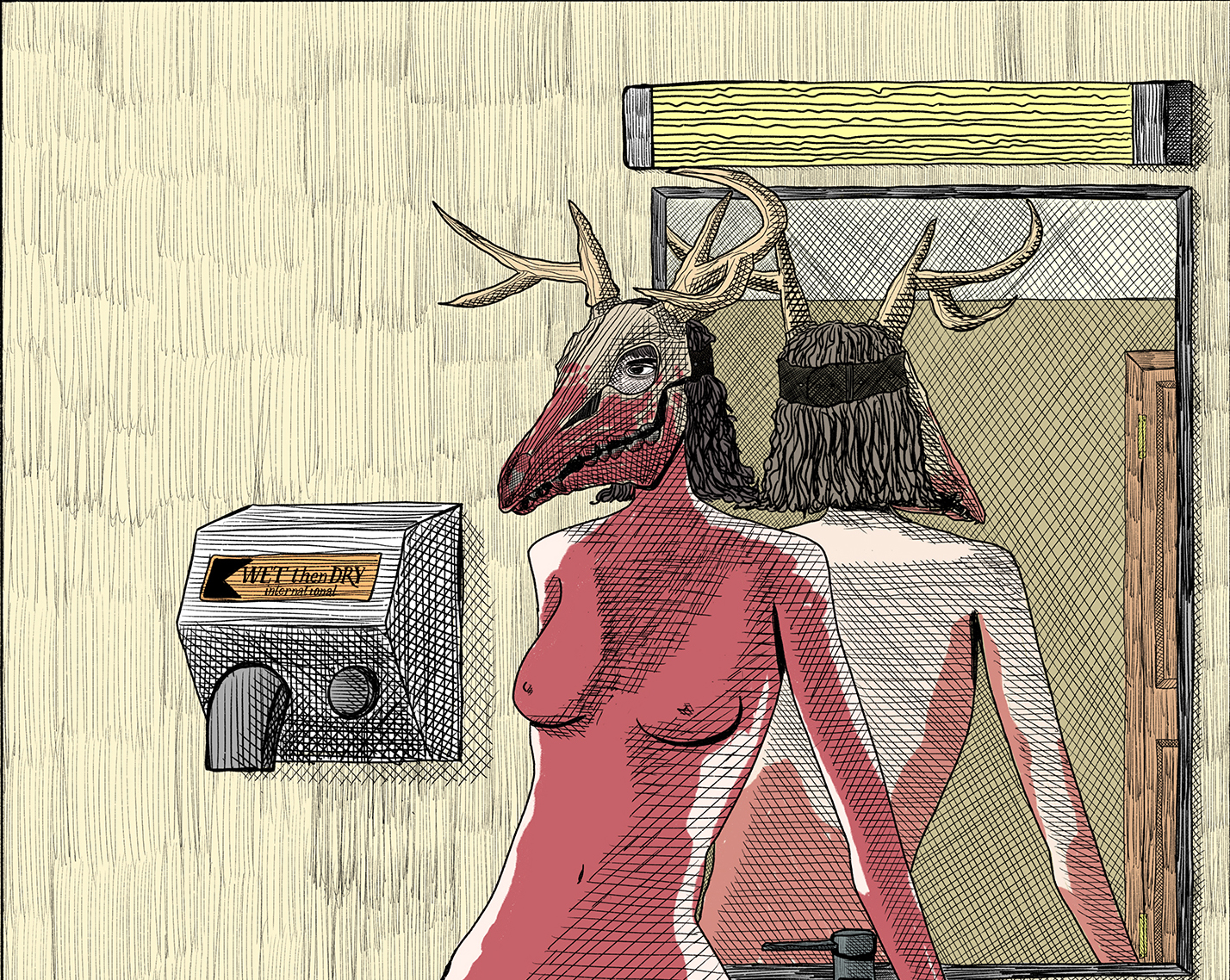
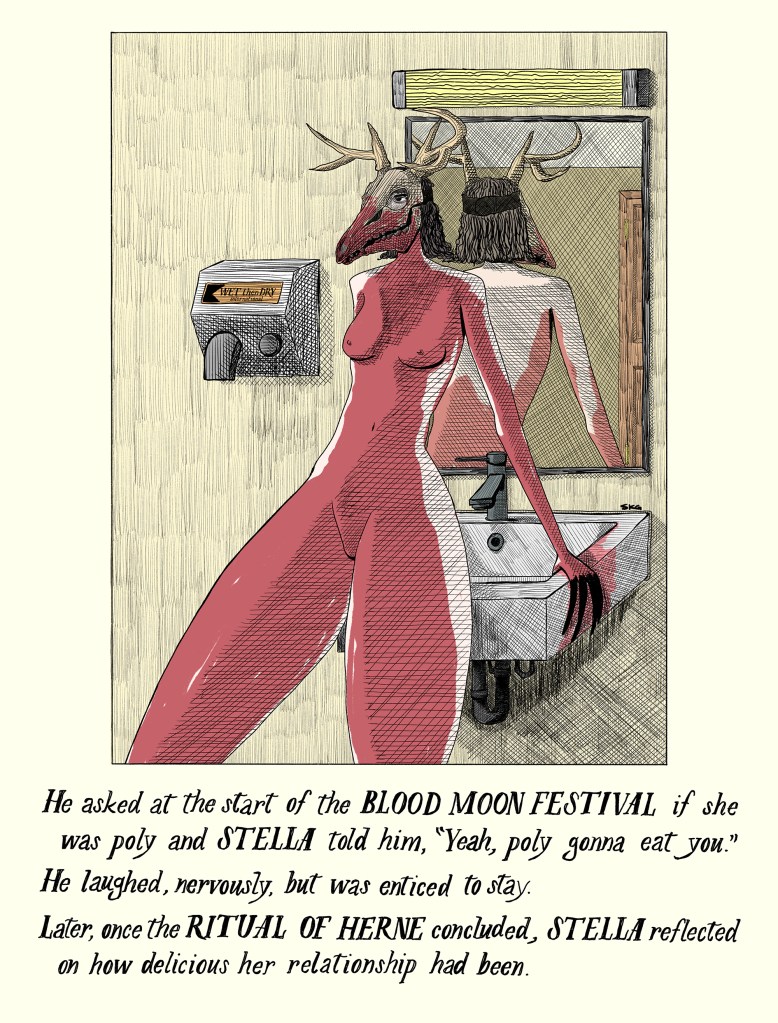
This illustration, Tasty Meal, seems to sit at the intersection of pagan mythology and pop culture. What was your inspiration for this piece, and how did it come together?
In all honesty, what inspired Tasty Meal was my love of horror movies, specifically horror movies that involve cults, especially cults whose rituals draw heavily from a gruesome, old-world paganism. What’s great about horror is that it takes the humdrum of everyday life and turns it dreadful, that no matter what you do, no matter how much insulation you wrap your life in, you cannot escape the violence waiting on the periphery as if your end is just one wrong turn away. (And if the twist is that the supernatural elements that’ve only been hinted at turn out to be real and the elder gods appear to wreck gory retribution, that’s perfection.)
So, when I set out to make Tasty Meal, I knew I wanted the piece to not only draw from the hyperreality seen in these types of flicks, but also have a touch of humor – since the best part of any horror is the moment of levity that occurs right before the terrible tragedy befalls the characters (and the bloodier the pagan ritual’s aftermath the better).
Who are your biggest artistic influences?
This is going to be a madcap list, but artists Edward Gorey and Mike Mignola, photographers Diane Arbus and Saul Leiter, and filmmaker Dario Argento.
How would you describe your overall aesthetic?
Drawing influence from a gamut of creatives and mixing them together taught me to appreciate the ghoulish side of the everyday, discover beauty in the mundane, and reveal the dignity of outsiders. Essentially, I strive to make the in-between moments of life picturesque whether the piece exists in the light or dark.
I’ve always been in awe of artists who are able to tackle the enormity of a graphic novel project. Tell me about Maya Milner Makes a Meal, what was the original inspiration, what has the process been like to get to pitch stage, where is it heading next?
The funny thing about my traipse into making a graphic novel, or at least the beginnings of a graphic novel, was I originally envisioned myself writing and drawing children’s books – a difficult profession to break into, but I persevered. One of the illustrated manuscripts I was most proud of was called Bathtime with Rio. After several edits, I sent it off and most of the responses I received were rejections, if I got a response at all.
There was one agent, however, who thought my writing and art showed promise, though she believed that Bathtime with Rio was too dark for kids. She suggested I put together a pitch for a graphic novel for a teenage audience. Inspired by folklore and monsters and my love of cooking, I combined these into a story about generational trauma and seeking new friends in a scary world where magic is ignored but not gone. Maya, the daughter of a chef, and her forest friend, a yeti-like creature who loves to paint, bond over the simple act of being invited over to sit at a table together and share a good meal.
I fleshed this all out in a detailed synopsis (along with putting together recipes to be included with the story), created character mock-ups and drew the first few pages, and emailed my pitch back to the agent. And that was it. I never heard back and my attempts at reaching out were disregarded, so I moved on and Maya Milner Makes a Meal currently sits in a drawer collecting dust. I occasionally think about returning to it, but I tend to quickly move on from projects without regret or desire to revisit them: When they’re put to bed, they stay asleep.
You’re currently working on your first animated reel, titled There Are Two Colors in My Head. Can you give our readers a sneak peek into the creation of this project?
I’ve always loved cartoons and used to make simple stop-motion films when I was younger. Nothing great, though I still have them on VHS. Silly projects to pass the time and amuse my friends. I still return to animation occasionally when I sense my artwork needs that extra ‘oomph’ to enliven it. I animated There Are Two Colors in My Head because I felt the piece, while enjoyable, was a tad stale. I wanted to test my abilities to see what I could produce while also turning what I thought was a good piece into a delightful one. The result has helped me to grow and map out a handful of other animation projects I plan to start in the coming months.
You have previously mentioned that your work has undergone a transition from darker or more political themes to a focus on entertaining snapshots of everyday life. What led you to this evolution, and why?
I pivoted away from the darker, more political themes due to one word: exhaustion. It’s difficult to maintain the rage and annoyance and stay in the narrow lane of being a reactionary. If you’re not careful, it’ll consume you, so I moved away from it. I didn’t check out. I merely adjusted my priorities and focus and once I allowed the process to start, I evolved, and my art really took off. There’s a wider world of creativity beyond snark and anger and takedowns that is nuanced and happy and vast and doesn’t take a toll on your mental health.
So as a painter who hasn’t had a consistent visual art practice in over 8 years, this question is dear to my heart. Talk to me about taking a break from art and finding it again in a different form. You have said that in your former practice, you thought you were a painter. You’ve since developed a vibrant body of work as an illustrator. What lessons have you taken away from this experience?
I’ve worn a number of hats throughout my professional life and stumbled through a lot of careers. I’ve tried my hand at being a journalist and a writer and a photographer and teacher and graphic designer. Intermingled with all these different jobs are brief spurts of retail jobs I’d rather not talk about. Throughout all of this, however, I’ve used creativity as an escape. At one point I saw myself as a painter because that was my escape at the time. Before that, I was a print cartoonist. Recently, as I mentioned, I attempted to break into children’s illustration. These escapes were worthwhile but never satisfying because they all reached an endpoint neither anticipated nor wanted. But I had to move on.
I never let myself get dissuaded, though, and kept pushing myself and exploring where I could go, confronting my fears and hesitations and always picking myself up after failures and brushing off the dirt and nursing my wounds and continuing to push forward while also understanding that the end goal is entirely unformed. I’m constantly reinventing and reinvigorating myself and my skills. Not to sound too hokey, but creativity has no map, it’s about taking the route less taken. The best plan is to have no plan and be excited to see where it all lands (while keeping all the terrified screams in your head).
What are you looking forward to for the year ahead?
Well, I’ve got a handful of publications ahead and looking forward to seeing my art out in the greater world. I’ve also got potential gallery opportunities to plan for as well as other chances to get my artwork in front of audiences. I’m also seeking representation, so I’m “patiently” awaiting word from the various agencies I’ve sought out. This is the plan for now, but like I said before, it’s really just a suggestion for the future.
Anything we haven’t asked about that you’d like to mention?
I think you’ve covered a lot. Hopefully, I didn’t ramble on too much.
Sean Gallagher lives in Charleston, South Carolina. His artwork has appeared or is forthcoming in Allegory Ridge, The Closed Eye Open, Passengers Journal, Vineyard Literary, Liminal Spaces, Fauxmoir Literary Magazine, Quarter Press, and High Shelf Press. He has also been highlighted as one of the lowcountry’s top emerging artists by Charleston Magazine.

 Beaver Magazine