
Questions by Shallom Johnson, Art Editor

Tell me a bit about the trip to Paris when these three photos were taken. Do these images have any particular memories associated with them?
When I travel abroad I make a point of visiting cemeteries as they are often a microcosm of the history and culture of the place I am visiting. The bronze statue gives us a life sized model (more accurate than a photograph) of the person buried there. It contains all kinds of information about 19th century life: clothing, grooming, etc. In France they often list the person’s professions and honors as well. The fallen leaves provide the alert viewer with the time (Fall) the image was made.
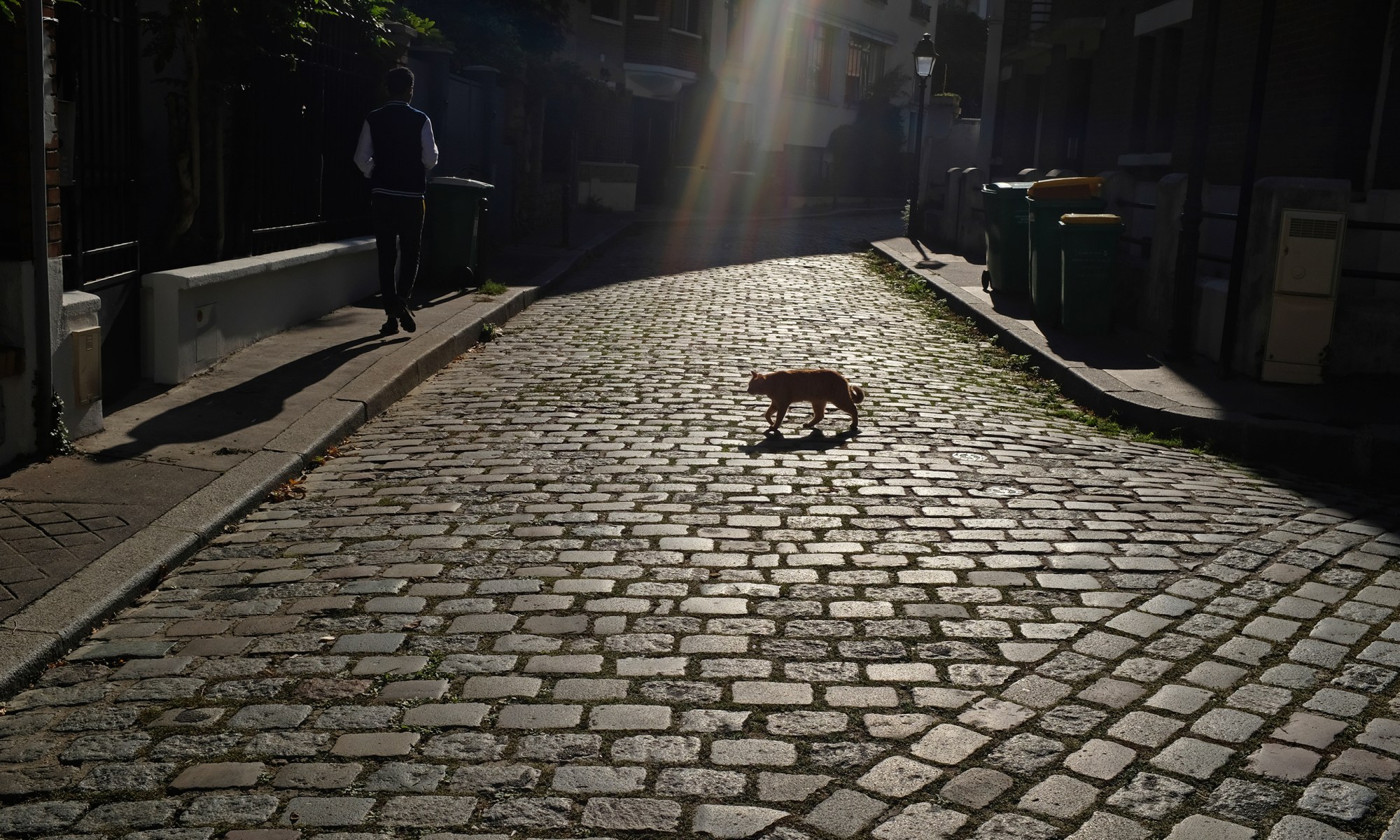
I like to explore Paris’s streets in the early morning light. I happened to look behind me just as this cat was crossing the street. It was one of those fortuitous moments, unplanned and unexpected and a wonderful memory as a result.
Your life as a photographer began during a long distance bicycle journey at age 15. With what intentions did you approach the act of documenting that initial journey? How have your intentions around travel photography evolved with time and maturity?
I have a scrapbook of that bicycle trip. Most of the photographs are snapshots of sights along the way or my camp at night. However, there are several images that go beyond those. One taken while actually riding the bike across the Mojave Desert. A rather unique point of view. Another of a row of boat hulls that is concerned with pattern and form. I simply don’t take photographs of tourist sites or of my wife or myself when traveling. I don’t travel with anything in particular in mind. I respond to whatever interests me in the moment.
Since I no longer maintain a studio where I might pursue a project over a period of years, my work primarily focuses on documentary photography. I am more interested in the little thing, some object or scene that might offer some insight into the place I am photographing, perhaps offering an epiphany. I am not drawn to the dramatic but to narrative mystery.

Which artists do you currently find inspiring, and why?
The artists who have most influenced my work are the French impressionists: Monet, Renoir, Gaughin and Van Gogh. For color and design. Among photographers who come to mind, Kertesz, Strand, Weston for their range of subject matter and composition.
In 2010, you retired from teaching and began writing poems full time. Has this life transition had an effect on your photography practice? Can you describe how things may have shifted?
I was teaching English at the university level and writing poetry when I made the decision to return to graduate school and get my MFA in photography. This was not an easy decision, but I promised myself that I would one day return to writing poetry and I’ve kept that promise. Now that I’m retired I have time to practice both. I write or rewrite daily. When I photograph, it is confined to my travels abroad although I have been known to photograph in my own backyard.
What do you see as the artists’ role in society today? Where do you feel your work (photography, poetry or otherwise) embodies, intersects with or diverges from that role?
Historically artists have often been at the forefront of change and have served as spokepersons for the marginal and silenced populations. Other artists have concentrated on bringing beauty and self-examination to the attention of viewers. I don’t think these roles have ever changed over millennia. I would say my work, both photographically and poetically, falls into the second category.

How do you cultivate and maintain a sense of curiosity about the world around you?
I have always put travel at the forefront of my priorities. That means making numerous sacrifices in order to afford the time and expense of travel. If one can not manage that, then books and documentary films can fill the void. We are fortunate to live in a country with free libraries, something we all take for granted but is not universal.
I just finished watching a seven hour series, The Story of India. Although I spent two months in India, I discovered I just barely scraped the surface of the country and I want to immediately return!
Any advice for creatives who are near the start of their journey?
Follow your own course. By that I mean look to yourself and not your contemporaries for inspiration. Look to the past, not only to your own country but to those countries who have thousands of years of history for you to examine and study.
Roger Camp is the author of three photography books including the award winning Butterflies in Flight, Thames & Hudson, 2002 and Heat, Charta, Milano, 2008. His work has appeared in numerous journals including The New England Review, Pank and the New York Quarterly. His documentary photography has been awarded Europe’s prestigious Leica Medal of Excellence. Represented by the Robin Rice Gallery, NYC, more of his work may be seen on Luminous-Lint.com.
 Beaver Magazine