

Conducted by Art Editor, Shallom Johnson
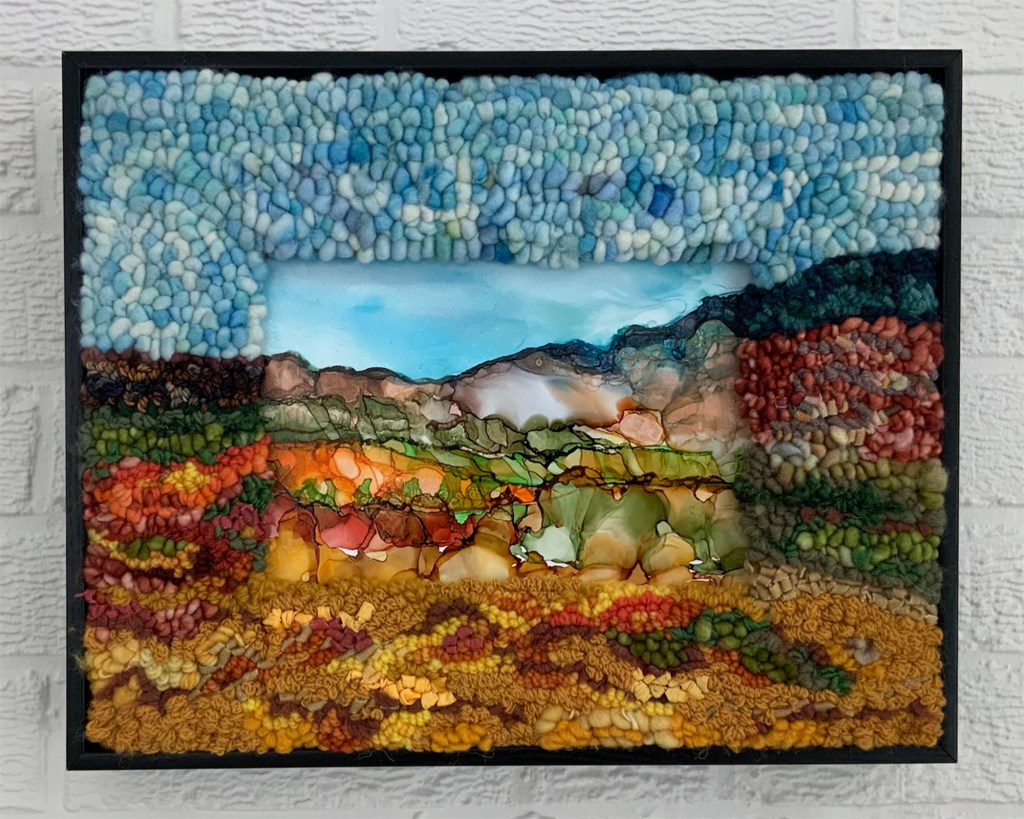
Thank you for taking the time to give our readers a window into your work! Can you walk us through the process of creating one of your artworks?
I usually see the piece in my mind’s eye before I begin work on it. I contemplate the visual and allow the details to unfold. When I feel the clarity of the vision, I begin the work. Most often, I paint first and then create the woolhooking portion of the piece.
Once the painting is completed, I take it into my wool hooking studio and begin selecting yarn and wool strips to complement the palette of the painting. Then I sketch a design for the piece and once I am pleased with the design, I hook the piece. It is fun to watch it all come together! Finally, I put the painting and wool piece together in a frame and hang it on the wall of my studio to study and enjoy.
You have described a connection to your grandmother, and her mother before her, through the making of wool hooked art. How have you brought this historical craft into the present day?
Wool hooking was known as rug hooking and at its beginning, it was a strictly utilitarian craft. Women would cut wool from whatever was on hand, such as old wool shirts or yarns from sweaters. Burlap feed bags were cut into the size of a run and stretched on a frame, and the wool was pulled with a hook through the openings in the burlap grid. Rugs were made to cover floors in rural areas long before they became machine made.
Because my grandmother enjoyed this art medium, and after I built a home on land that originally belonged to her on Prince Edward Island, Canada, I felt inspired to learn the art form that brought her such pleasure and sense of accomplishment. At present, wool hooked pieces are considered an expression of fiber art, and are shown in galleries and museums. My work has been accepted for gallery shows and juried art exhibitions, which has been a joy for me and a method of bringing this century old craft forward into the art world of today.

When did you start mixing wool hooking with painting, and how has this body of work changed or developed since then?
I purchased an art print by a well known artist from Prince Edward Island. It portrayed a red fox overlooking the sea from a cliff’s edge. I liked the print so much that I decided to make a pattern of the subject matter, and I hooked it with colorful yarns. I hung it beside the print of the painting on my porch on Prince Edward Island.
I looked at the print and hooked piece all summer long, and one day, I got the idea to combine the modalities after studying the effect of these two pieces in my mind. I heard my inner voice say, “Woolpaint”, and the words stayed with me. From then on I experimented with acrylic painting, collage, oil painting, alcohol ink and wool hooking to see how the effects of combining these modalities into Mixed Media art pieces that felt unique in my expression. My work continues to evolve.
Can you speak a bit about the inspiration for these three artworks in particular?
My inspiration is driven by my visionary experiences of an art piece. The beauty of the natural world’s landscape and animals represented in these pieces are an expression of my inspiration drawn from the world around me.
How does your creative process help you feel rooted to a sense of place, or belonging?
My work contains a continuous thread leading back to my grandmother and my ancestors in Canada and the United States. A sense of family informs my work.
What do you hope to communicate with your work?
Beauty. To paraphrase John Keats, in beauty is truth, truth is beauty. I don’t make angry or sad art. I try to celebrate the natural beauty of life.

Who are your biggest artistic influences?
My grandmother and the art and life of Georgia O’Keefe are by big influences. Many artists influence me, but I truly try to find my own way. I listen to that strong voice within, and although I admire many, I am compelled to express my individuality. I believe the artist within is like a fingerprint, unique and different from anyone else.
What have been your most fulfilling moments to date, as an artist?
When I am lost in the moment of painting or wool hooking I feel the most alive and filled with a sense of meaning. Having my art chosen for a show is a thrill just as making a sale makes my heart sing. But it is in the making where I feel most fulfilled.
What are you looking forward to for 2023?
I am working on a new collection I call The Grazers. It consists of portraits of animals, their individual faces call to me and make me smile.
Where can our readers see more WoolPaintArt?
You can find me at woolpaintart.com or on instagram @artful_woolpaint.
 Beaver Magazine
Nice post
LikeLiked by 1 person